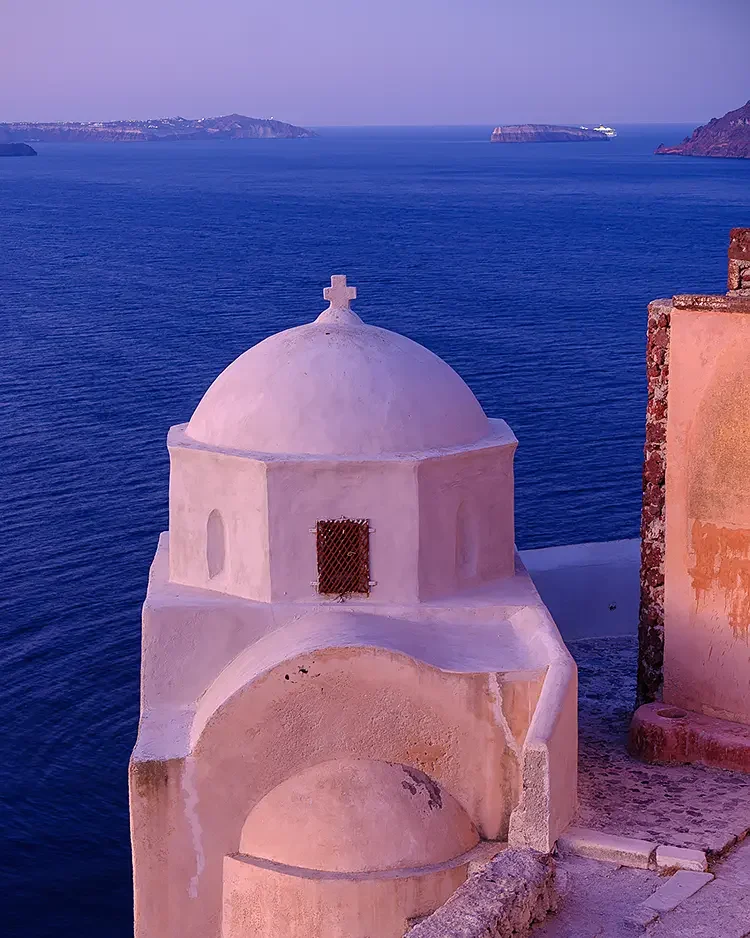
Prior to sunrise, the chapel of Agios Nikolaos Kastrou seemed to momentarily revert to its original state. The chapel stood quietly above the caldera, its pale dome catching the first hints of colour while the sea below remained a deep, Mediterranean blue. I arrived early for a simple reason: this spot belongs to photographers only for a short window each day. Once the sun rises, Oia fills with movement and noise; before that, there is space to see and to breathe.
As a landscape photographer, I often arrive with a clear plan. I know where I want to stand, how the light might behave, and what kind of balance I am looking for in the frame. Yet, standing there in the pre-dawn stillness, those plans softened. The light did not perform; it settled. It revealed texture rather than drama. The chapel walls showed their age through gentle wear and uneven surfaces, signs of time rather than neglect. I framed the dome against the open sea, letting the calm geometry of the building speak without forcing it into something more dramatic than it needed to be.
What stayed with me most was the silence. Without voices or footsteps, the village felt suspended. Every small movement mattered: adjusting the tripod, checking focus, waiting for the light to lift just enough. In that quiet, I felt less like a visitor and more like a witness. The act of photographing became slower, more deliberate, guided as much by feeling as by technique.
Across the water, the outlines of the caldera islands slowly emerged, softened by the early light. A cruise ship hovered on the horizon, a familiar presence in these waters. From this vantage point, however, it felt removed from the scene as it was almost hidden behind the island. My focus remained on the relationship between the chapel and the sea, between human structure and open space, and on the sense of balance that defined the moment.
That atmosphere shaped the way I approached the photograph. I avoided exaggeration, strong contrast, or dramatic colour shifts. The intention was not to impress, but to remain faithful to what was unfolding. I wanted the image to feel calm and grounded, reflecting the quiet strength of the place rather than imposing a narrative upon it. Restraint felt appropriate; the scene did not ask for more.
When I finally pressed the shutter, the feeling was one of quiet satisfaction rather than excitement. The photograph was not about securing a well known viewpoint. It was about presence, patience, and attention. As the sky continued to brighten and the first sounds of the village began to return, I packed my equipment, knowing the moment had passed. What remained was an image shaped by stillness, and a reminder of why I seek out these early hours, when places briefly reveal themselves without interruption.
In recent times, seismic activity in the region has introduced a new sense of uncertainty to the island. Even though not much visible damage occurs, the awareness of movement beneath the ground can alter how a place is perceived and experienced. For Santorini, where the island depends on tourism, this has had a noticeable effect. Travel plans have been reconsidered, visitor numbers have fluctuated, and the familiar rhythm of arrivals has been interrupted. The island remains visually unchanged, yet the context surrounding it has shifted, reminding both residents and visitors that even destinations shaped by permanence and history are not immune to forces beyond human control.