Classic and iconic scenes are undeniably compelling; they can be visually striking and deeply rewarding to photograph. Most landscape photographers strive to experience these places under the best possible light and to render them with care, while still applying a personal vision to something that has been photographed many times before.
Over the years, I have often heard people say that they avoid iconic locations because they feel those places have already been ‘done to death’. By that logic, much of the United Kingdom, and likely many other countries, would be off limits to photography altogether. If every well known location were dismissed on those grounds, one might reasonably ask whether there is any point in continuing at all. I do not subscribe to that way of thinking.
I know photographers who, for this very reason, do not have a single image from classic or iconic locations. This has always struck me as a missed opportunity. The UK — and many other countries — is rich in extraordinary landscapes, and resisting the urge to photograph them requires a level of restraint I simply do not possess. More importantly, how can you grow as a photographer without testing personal vision against scenes that have challenged and inspired others? Competition, whether acknowledged or not, is one of the forces that pushes us to improve; it is a simple fact of creative life.
The answer, at least for me, lies in interpretation. There is no obligation to replicate what has already been done. A location can be revisited endlessly and still offer something new when viewed through a different artistic lens. If landscape photography is to be considered an art form, then we must allow ourselves to behave like artists. A scene is never static; it is shaped by mood, light, season, weather, and even the emotional state of the person standing behind the camera.
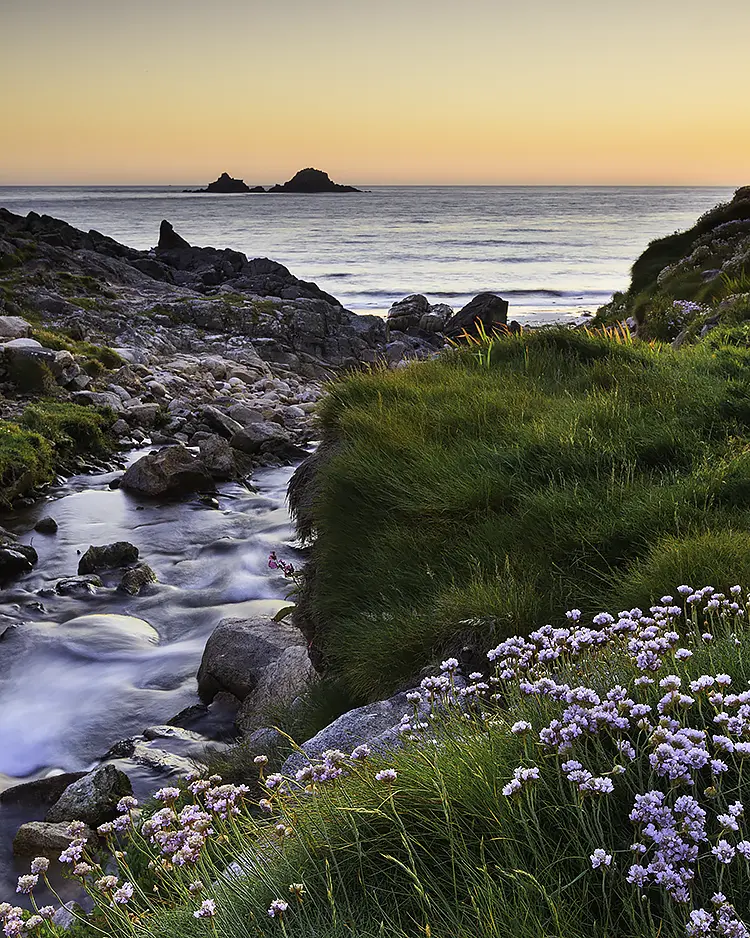
This image from Porth Nanven in Cornwall is a good example of that approach. Some will immediately recognise the location by the two offshore islands; others may not. Porth Nanven is well known, and most photographers who visit are drawn to a single, familiar composition: the large rounded pebbles revealed at low tide.
Those images initially inspired my visit, but I arrived with an open mind. The bay itself is much smaller than I had anticipated, yet I spent over forty-five minutes exploring and observing before committing to a composition. In the end, I chose to exclude the pebbles entirely. They did not feel essential to the story I wanted to tell. Instead, I was drawn to the broader character of the place: the structure of the shoreline, the quiet presence of the islands, and the calm, contemplative atmosphere of sunset.
Standing there in the late light, I felt both focused and at ease. The familiarity of an iconic location was balanced by the satisfaction of seeing it differently. That moment of alignment, between place, light, and intent, is what I seek most in landscape photography. This image is my interpretation of Porth Nanven; an iconic location approached from a different point of view, shaped by patience, observation, and personal connection.