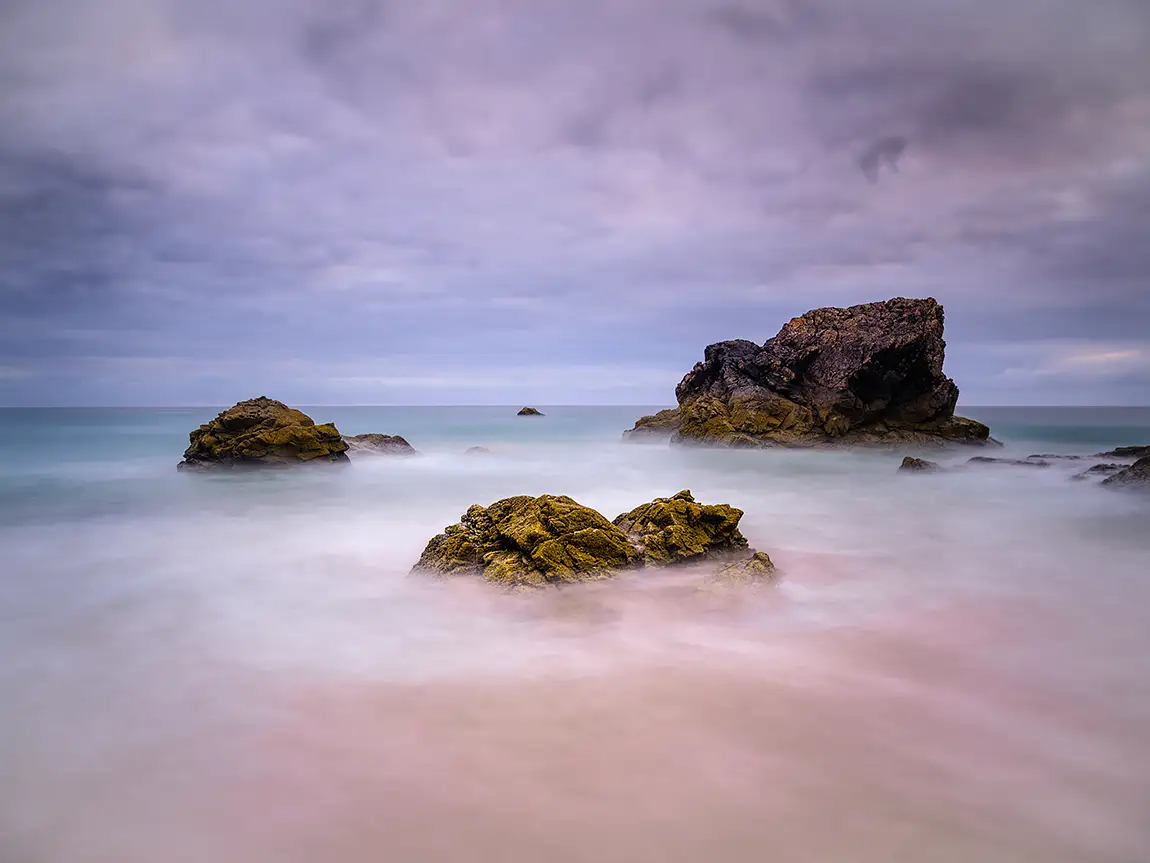
The tide rolled in, waves folding over one another in a constant, hypnotic rhythm, spraying fine mist against the cliffs. Each light gust carried the scent of the North Atlantic, briny and sharp, and the sand beneath my boots shifted with every step. Overhead, clouds scudded across the pale sky, catching the last hints of fading light. I breathed it all in—the smell, the sound, the motion—and for a moment, everything else fell away.
Even there, however, in a place that seems designed for photography, frustration can creep in. I have seen it in others and, in my early years, I felt it myself. The question is: how do you avoid it?
For me, it begins long before I lift the camera. On that early morning, as I wandered the bay, I let my eyes follow the lines of the shoreline, the jagged rocks rising from the sand, the small pools reflecting the soft sky. I wasn’t thinking about filters, tripods, or settings. I was listening to the scene, letting it guide me. Only when a composition felt right did I set up my gear, slowly and deliberately.
The steps that follow—focusing, balancing exposure, adjusting ND grad filters—have become second nature. I move through them almost without thought, like a musician running through a familiar piece. Occasionally, I pause, wondering if I have focused correctly, only to find I have. These routines, once a source of anxiety, are now my shield against frustration.
I remember the early days as an enthusiastic amateur. Standing on a similar beach, perhaps in the Outer Hebrides, I would hunt desperately for a composition, wrestle with focus, agonize over which ND filter to use. Every step felt critical, every decision fraught. Long exposures required endless calculations. The pressure was constant, and the joy of the landscape often felt just out of reach.
I understand now why frustration so easily takes hold. The process is complex, and when you are still learning, every step can feel overwhelming.
When I work with clients who feel this frustration, I take a different approach. We begin by simply being in the location—always allow two hours—with no pressure to capture a picture immediately. I encourage them to explore, to sit, to breathe. When the moment feels right, we move through the technical steps together, carefully, deliberately, ensuring that each image is crafted with intention. By slowing down, by giving time to the landscape itself, the anxiety melts away.
The lesson is simple: relax, take your time, and let the location guide you. Frustration only finds you when you rush, when you try to force the image instead of letting it emerge. Spend the hours, embrace the quiet, and the landscape will reward you; not with perfection, but with a sense of calm, a photograph born from presence rather than haste.